The underlying science of drying out a water-damaged space doesn’t change depending on the building type. Water still wicks the same way through drywall, wood, and carpet padding whether it’s in a living room or a hotel corridor. What changes, often dramatically, is everything around that science: who’s affected, how the space is triaged, what documentation is required, and how much a single day of delay actually costs. Property managers and business owners who assume commercial mitigation is “the same job, bigger building” are usually surprised by how different the logistics really are.
Does the drying standard itself change for commercial buildings?
No. The ANSI/IICRC S500 standard, now in its Fifth Edition (2021), governs professional water damage restoration procedures for residential, commercial, and institutional buildings under the same framework. The same categories of water contamination, the same psychrometric principles behind drying equipment placement, and the same moisture-monitoring discipline apply whether the affected space is a single-family home or a 40-room hotel. A restoration company that understands S500 is equipped to work in either setting, because the physics and the industry standard don’t distinguish between them.
So what actually is different?
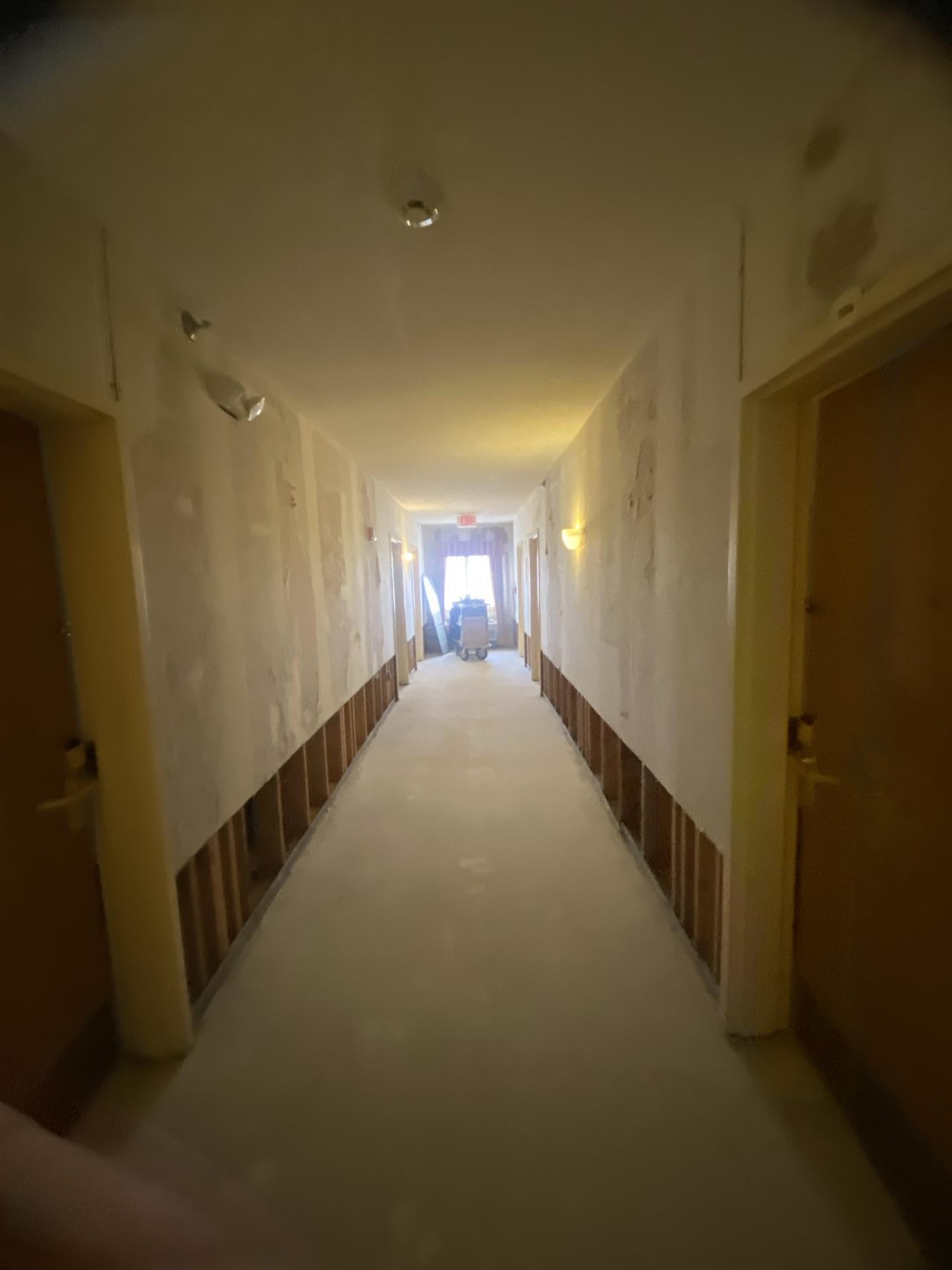
Occupancy and disruption tolerance. A residential water loss typically affects one household, and the people living there are usually already aware something happened. A commercial water loss, especially in a multi-tenant or multi-unit building like a hotel, office complex, or apartment building, can affect people who had nothing to do with the source of the problem and may not even know it occurred yet. What’s pictured here, a hotel corridor with a housekeeping cart still staged along the wall, illustrates the point: guests are moving through this space, staff are actively working in it, and any mitigation plan has to account for people who are present and functioning in the building, not just the physical damage itself.
How does triage work differently in a commercial building?
In a residential job, triage is usually straightforward: assess the affected rooms, start drying, done. In a commercial building, triage has to answer a harder question first, which spaces are structurally affected, which are cosmetically affected, and which are completely unaffected but sit close enough to need monitoring. Getting that wrong in either direction causes real problems. Under-triaging means missing damage that spreads into an adjacent unit weeks later. Over-triaging means displacing tenants or shutting down operational areas that were never actually at risk, which in a commercial setting has a direct cost attached to every closed hour.
Why does documentation matter more on the commercial side?
Because commercial losses almost always involve more moving parts on the insurance side. A single event can touch a property owner’s policy, a tenant’s or operator’s policy, and sometimes a shared-system liability question if the source was something like a common roof or a building-wide plumbing line. Photo and moisture-reading documentation captured at the start of the job, not reconstructed from memory afterward, is what keeps a multi-party commercial claim moving instead of stalling over disputes about what was damaged and when. Residential claims usually involve one homeowner and one carrier, which is a meaningfully simpler paper trail.
What does a multi-tenant building need that a single-tenant space doesn’t?
A hotel is a useful example precisely because it combines several of these challenges at once. Guests are actively occupying rooms near the affected area, staff need clear guidance about which corridors, elevators, or amenities remain usable, and the property still has to function as a business throughout the mitigation process, not pause entirely while drying equipment runs. That’s a different operational puzzle than a single-tenant office that can simply be closed for a few days. The same logic applies to apartment buildings, medical office complexes, and retail centers with shared walls or shared mechanical systems: a water event in one unit is rarely just that unit’s problem, and a mitigation plan that doesn’t account for the building’s other occupants isn’t a complete plan, even if the drying itself is done correctly.
Does the cost of delay actually differ between the two?
It’s the same principle, water gets more expensive to fix the longer it sits, but the dollar stakes scale differently. A residential delay usually costs more in materials and repair scope. A commercial delay costs that too, plus lost operating revenue for every day a space stays unusable, plus, in a case like a hotel, the reputational cost of rooms or common areas being out of service during business hours. That combination is exactly why commercial response protocols tend to emphasize speed and clear tenant communication even more heavily than residential ones do, not because the water behaves differently, but because the cost of a slow response compounds faster.
What should a property manager actually take from this?
Trust that the restoration science is consistent, but don’t assume the logistics are interchangeable. A residential-focused contractor without commercial experience may understand drying perfectly well and still struggle with multi-tenant communication, phased documentation, or triage decisions that affect people who never even filed a claim. The building type doesn’t change what water does. It changes almost everything about how the response has to be managed around it.
By the numbers:
- The ANSI/IICRC S500 standard, now in its Fifth Edition (2021), is the water damage restoration industry’s governing reference for procedures across residential, commercial, and institutional properties.
- The U.S. experienced 27 separate weather and climate disasters in 2024 that each caused at least $1 billion in damage, totaling $182.7 billion, according to NOAA’s National Centers for Environmental Information.
- Roughly 1 in 60 insured U.S. properties files a water damage or freezing claim in a given year, with an average claim cost of $15,400 (2019-2023 average), per the Insurance Information Institute.
Sources: ANSI/IICRC S500, Standard for Professional Water Damage Restoration, 5th Edition; NOAA National Centers for Environmental Information, “Assessing the U.S. Climate in 2024”; Insurance Information Institute, “Facts + Statistics: Homeowners and Renters Insurance”
Call Ram Restoration to schedule a commercial water damage assessment: 937-885-0088 or www.ramrestorationusa.com