For a commercial property manager, a water loss isn’t just a maintenance issue, it’s an operations problem with a dollar figure attached to every hour it stays unresolved. Tenants need functioning space, businesses need to reopen, and every hour spent deciding what to do instead of doing it adds directly to the eventual cost and the closure timeline. The good news is that downtime after a commercial water event is largely determined by decisions made in the first 24 hours, and most of those decisions are within a property manager’s control.
The first decision is who gets called, and how fast. Commercial water mitigation runs on the same core principle the restoration industry follows for any water loss: the ANSI/IICRC S500 standard, which governs professional water damage restoration procedures for residential, commercial, and institutional buildings alike. That standard exists because water damage isn’t static. Materials that could have been dried and saved on day one often can’t be saved by day three, once moisture has had time to wick further into structural materials, flooring, and wall assemblies. A property manager who treats “we’ll assess it Monday” as an acceptable timeline is often turning a contained, dryable loss into a materials-replacement job by the time anyone shows up.
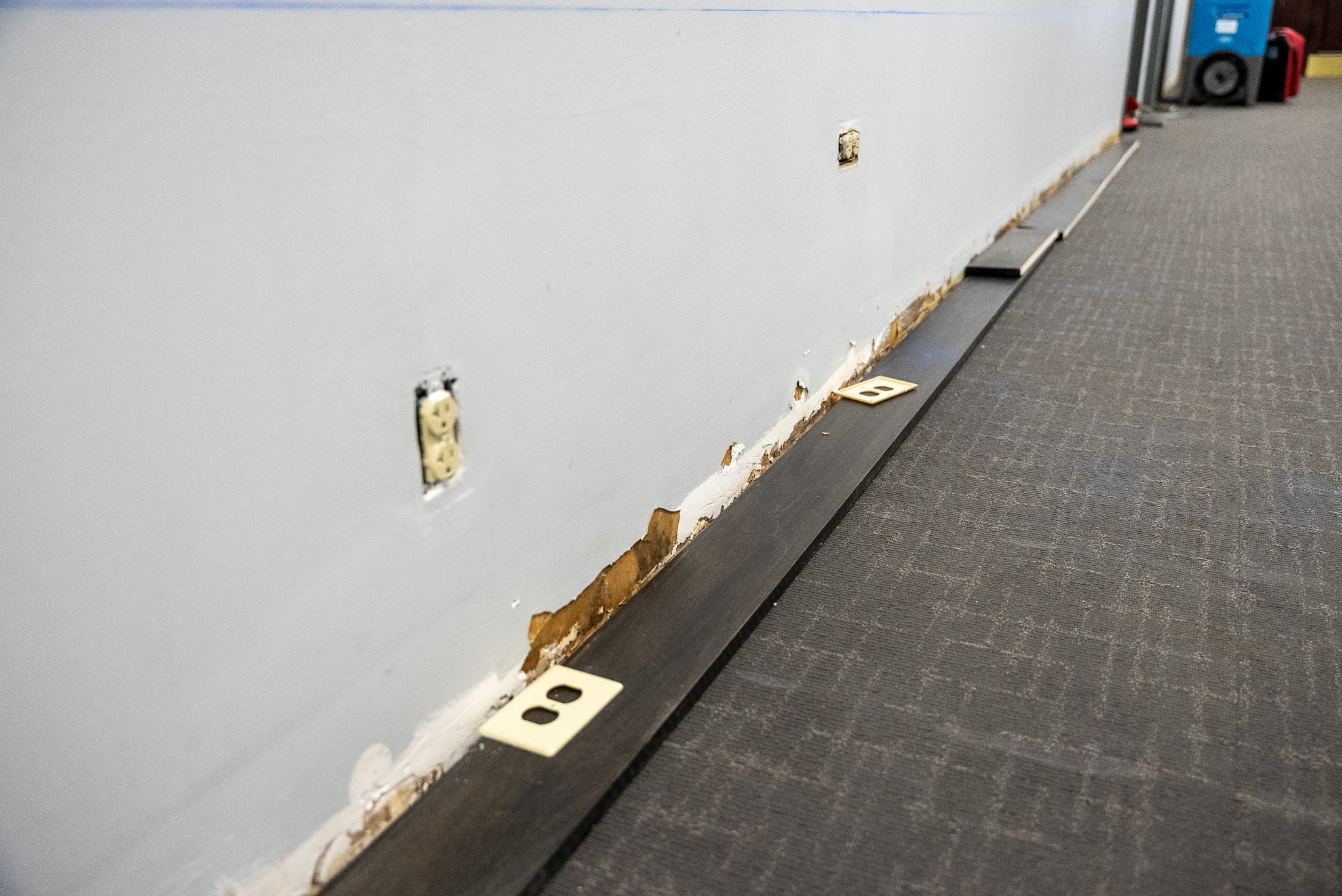
The second decision is how the space gets triaged. Commercial buildings are rarely a single occupancy, which means a water event in one unit, one floor, or one mechanical space can affect tenants who had nothing to do with the original problem. Effective triage means identifying which spaces are structurally affected, which are cosmetically affected, and which are unaffected but need monitoring, so that tenants in unaffected areas aren’t displaced unnecessarily and tenants in affected areas get clear, honest timelines instead of vague reassurance. What’s pictured here, a hallway with drywall and baseboard already removed down to the studs, commercial carpet tile still in place, and drying equipment already staged, is a textbook example of controlled triage: only the materials that couldn’t be saved were removed, and the drying process started immediately rather than waiting for a full remediation plan to be finalized.
The third decision, and the one most property managers underestimate, is documentation. Commercial water losses almost always involve insurance, and often involve more than one policy (a property owner’s policy, a tenant’s policy, sometimes a third party’s liability coverage if the source was a shared building system). Photo and moisture-reading documentation taken at the start of a job, not reconstructed afterward from memory, is what actually moves a commercial claim forward without disputes over what was damaged, when, and how badly. A restoration team that documents as standard practice, rather than as an afterthought, is protecting the property manager’s timeline as much as the tenant’s.
None of this means every commercial water event turns into a multi-week closure. Most don’t, when the first 24 hours are handled correctly. A single office suite with a failed supply line, caught and responded to quickly, can often be back in operation within days rather than weeks, precisely because drying started before the damage had a chance to spread into adjacent framing and flooring. The buildings that end up with extended closures are usually the ones where the response was delayed, not the ones where the damage was unusually severe.
For a property manager, the practical takeaway is to have the decision made before the emergency happens, not during it. Knowing in advance who to call, what documentation to start capturing immediately, and which spaces in the building are most vulnerable to a fast-moving water event turns a chaotic first day into a managed one. That’s the difference between a water loss that costs a few days of disruption and one that costs a few weeks.
By the numbers:
- Water damage and freezing account for about 1 in 60 insured property claims annually, with an average claim cost of $15,400 (2019-2023 average), per the Insurance Information Institute.
- Ohio recorded 105 separate billion-dollar weather and climate disaster events between 1980 and 2024, with severe storm events making up 65.7% of that total, and a recent five-year average (2020-2024) of 7.2 such events per year, up sharply from the long-term average, per NOAA’s National Centers for Environmental Information.
- The ANSI/IICRC S500 standard, now in its Fifth Edition (2021), is the water damage restoration industry’s governing reference for procedures across residential, commercial, and institutional properties.
Sources: Insurance Information Institute, “Facts + Statistics: Homeowners and Renters Insurance”; NOAA National Centers for Environmental Information, “Billion-Dollar Weather and Climate Disasters: Ohio”; ANSI/IICRC S500, Standard for Professional Water Damage Restoration, 5th Edition
Call Ram Restoration to schedule a commercial water damage assessment: 937-885-0088 or www.ramrestorationusa.com