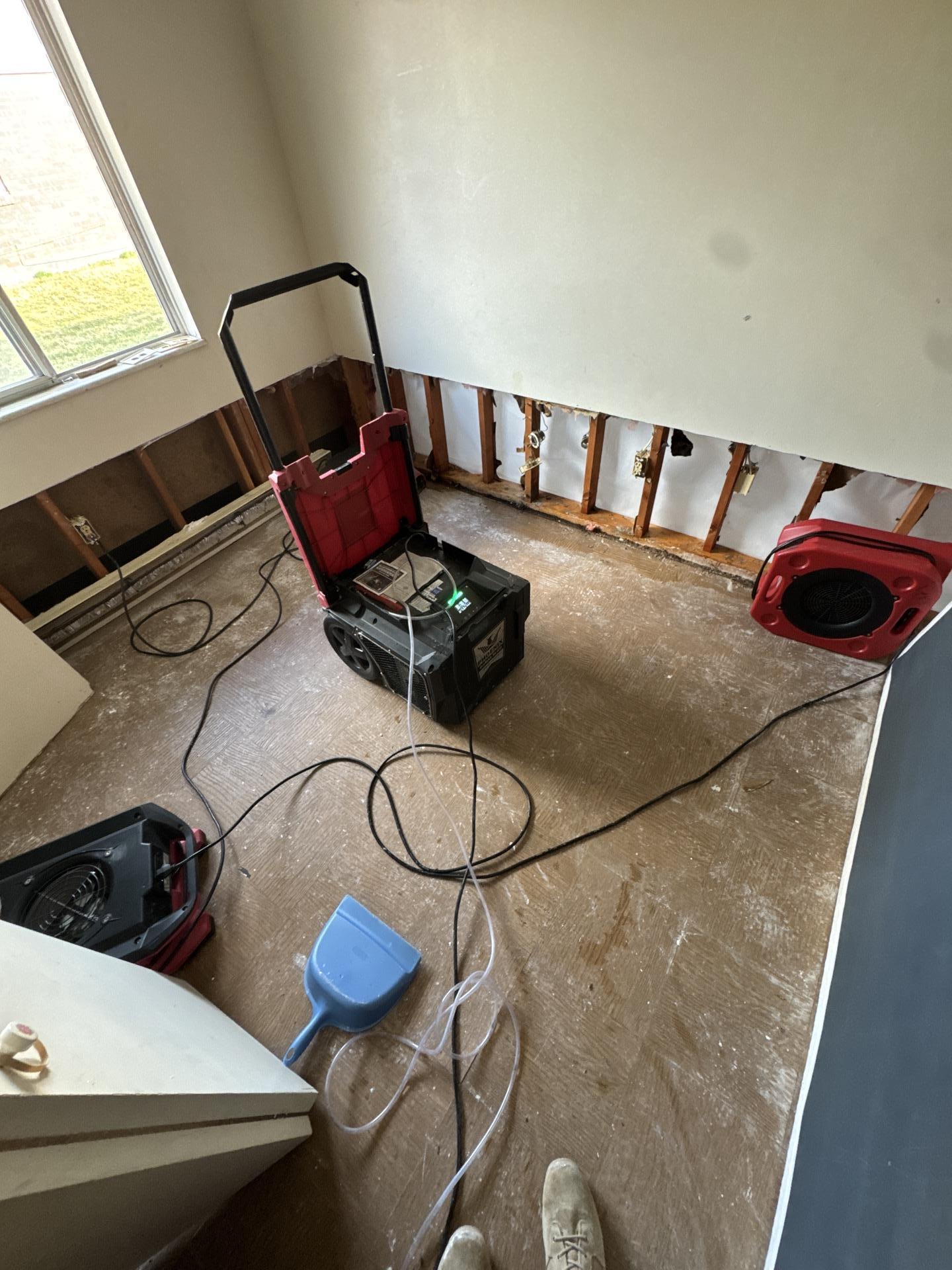
By definition, the water damage that causes the most long-term trouble is the kind nobody sees right away. A storm that drives water behind siding, a slow supply-line leak inside a wall cavity, groundwater wicking up through a slab, none of these announce themselves the way a burst pipe or an overflowing appliance does. What’s pictured here, drywall already cut away to the studs with drying equipment running in the open cavity, is what a restoration team finds once hidden damage is actually exposed. Knowing what to look for before it gets to that point is the real value of understanding how hidden water damage develops.
Why isn’t hidden water damage just “hard to see”?
Because in a lot of cases, it’s actively concealed by the structure itself. Water that enters through storm-driven wind-blown rain, a roof or flashing failure, or a slow plumbing leak inside a wall often travels along the inside of that wall cavity, framing member, or subfloor assembly before it ever reaches a surface a homeowner would notice. By the time a stain, bubble, or soft spot becomes visible on the finished surface, the water has typically already been present, and already wicking into surrounding materials, for a meaningful length of time. The visible sign is a late-stage symptom, not an early warning.
What are the actual early warning signs worth knowing?
A few show up consistently, even before any visible staining appears. A musty smell in a specific area that doesn’t match the rest of the house is one of the most reliable, since it usually means moisture has been sitting long enough to start supporting microbial activity, per EPA guidance on mold and moisture control. Flooring that feels slightly soft or “springy” underfoot, paint or wallpaper that looks subtly different in sheen or texture in one localized spot, or a baseboard that seems to be separating slightly from the wall are all signs worth investigating rather than dismissing, since all three can indicate moisture working on a material from behind or underneath.
How does professional water damage classification factor into an assessment like this?
Restoration professionals evaluate water intrusion using the category system defined in the ANSI/IICRC S500 standard, which classifies water by its level of contamination: Category 1 is water from a clean source with no substantial contamination risk, Category 2 is water that carries some degree of contamination and could cause discomfort or illness if contacted, and Category 3 is grossly contaminated water capable of causing severe illness. That classification matters for a hidden-damage assessment because it changes the response: a slow, clean supply-line leak behind a wall is handled differently than storm-driven water that may have picked up contaminants on its way into the structure, even though both can look identical once a wall cavity is finally opened up.
Why does storm-driven water get into places a normal leak wouldn’t?
Wind-driven rain during a storm behaves differently than a simple leak, because wind pressure can force water through gaps, seams, and penetrations that would never let water through under still conditions, around window flashing, through soffit vents, along roof-wall transitions. That’s part of why the current edition of the S500 standard specifically addresses wind-driven rain as a water intrusion pathway. A house can come through a storm with no obvious exterior damage and still have water actively working its way into a wall cavity through one of these pressure-driven entry points.
Are there warning signs specific to a slab or a crawlspace, versus a wall cavity?
Yes, and they’re worth knowing separately since the mechanism is different. In a home on a slab foundation, hidden moisture often shows up first as flooring that feels cool or slightly damp in one specific area with no obvious source, or as a faint discoloration line at the base of a wall where groundwater has been wicking upward through the concrete. In a home with a crawlspace, the more reliable early sign is often smell rather than anything visible, since a damp crawlspace can affect the air quality of the rooms above it well before any staining appears on a visible interior surface. In both cases, the pattern is the same one described above: the symptom that’s easy to notice, like a musty smell, tends to arrive before the symptom that’s easy to see, like a stain.
What happens once hidden damage like this is actually found?
The response shown here is standard: affected drywall gets cut away to expose the full extent of the wet material, not just the visibly stained section, since moisture typically travels further than the stain suggests. Subfloor and framing are checked directly with moisture meters rather than assessed visually. Drying equipment, air movers and a dehumidifier working together, gets deployed into the open cavity itself, because drying a wall from the outside once it’s closed back up is far less effective than drying the structural materials directly. This is also why “just repaint over it” is rarely a real fix for anything beyond the most minor, already-dry staining, since repainting addresses the visible symptom while leaving the actual wet material in place behind it.
What’s the practical takeaway for a homeowner?
Don’t wait for a stain to appear before taking a musty smell, a soft floor spot, or a subtly separating baseboard seriously. Those signs typically show up before the damage is visible on a finished surface, not after, and catching hidden water damage in that earlier window is what keeps a repair contained to drying and monitoring instead of the kind of open-wall remediation pictured here. If a storm event, a known leak, or persistent unexplained odor raises any question about what might be happening behind a wall or under a floor, a moisture assessment answers that question directly, without guessing.
By the numbers:
- The ANSI/IICRC S500 standard classifies water intrusion into three categories, from Category 1 (clean source) to Category 3 (grossly contaminated), which determines how a restoration response is handled.
- Ohio recorded 105 separate billion-dollar weather and climate disaster events between 1980 and 2024, with severe storm events making up 65.7% of that total, per NOAA’s National Centers for Environmental Information.
- Water-damaged materials need to dry within 24 to 48 hours to prevent mold growth from taking hold, per EPA guidance on mold and moisture control.
Sources: ANSI/IICRC S500, Standard for Professional Water Damage Restoration, 5th Edition; NOAA National Centers for Environmental Information, “Billion-Dollar Weather and Climate Disasters: Ohio”; U.S. Environmental Protection Agency, “A Brief Guide to Mold, Moisture and Your Home”
Call Ram Restoration to schedule a water damage assessment: 937-885-0088 or www.ramrestorationusa.com