A wall can look completely dry and still be holding enough moisture underneath to cause problems weeks later. That gap between what a surface looks like and what it actually measures is why drying work doesn’t end when the visible water is gone.
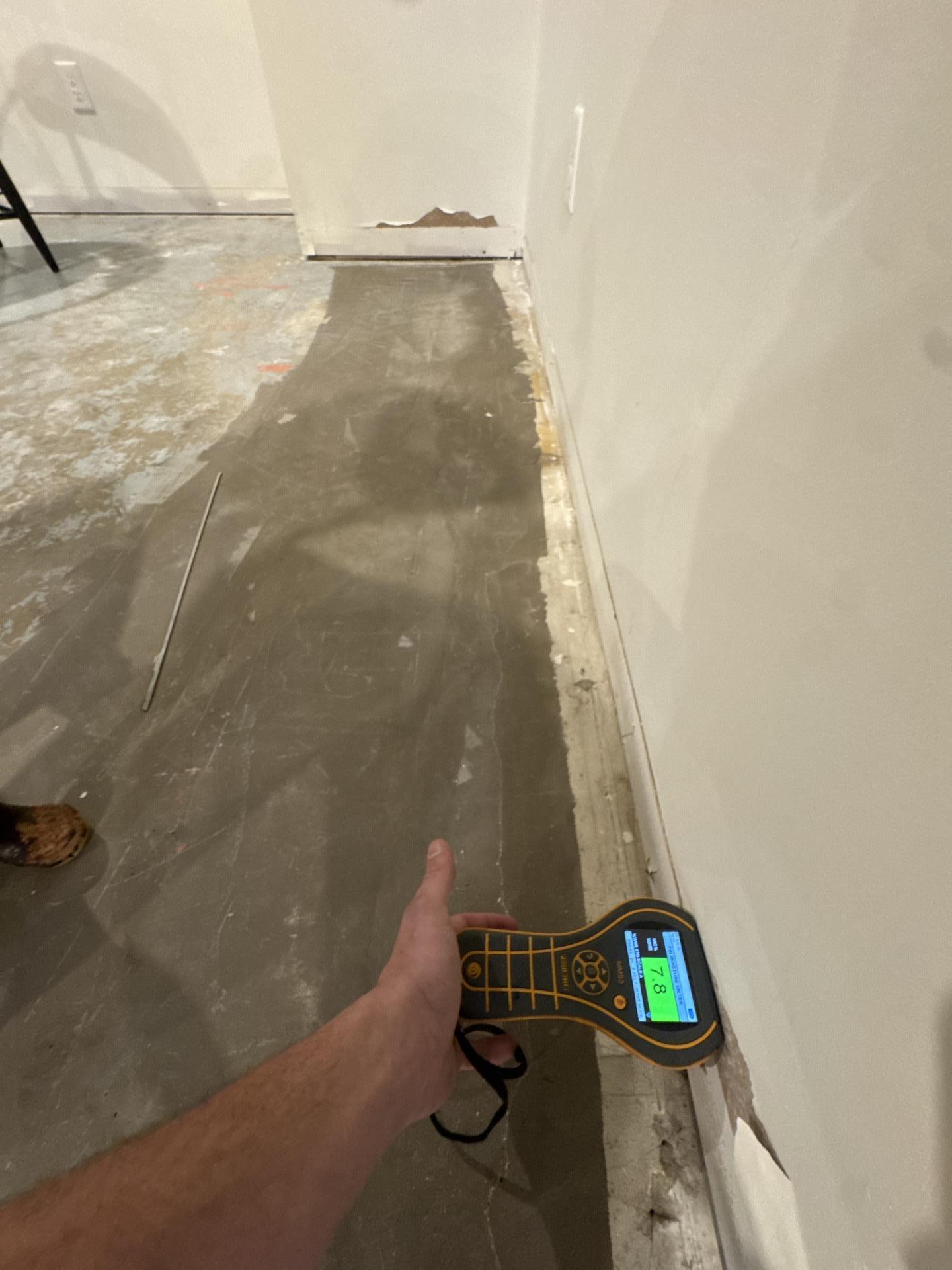
A moisture meter reads what the eye can’t. Pressed against drywall, framing, or a wall corner like the one pictured, it gives a number rather than a guess, and that number is checked against the readings other, unaffected parts of the same home give as a baseline. Ram Restoration follows that same measure-and-document approach on every water damage assessment across Dayton and the surrounding Miami Valley, using the readings to decide when a space is genuinely dry rather than when it merely looks that way.
This matters because drying by eye leads to two bad outcomes: stopping too early, which leaves moisture trapped behind walls where it has time to cause secondary damage, or running equipment longer than necessary in spaces that were already fine. Measuring removes the guesswork in both directions, and it gives a homeowner or an adjuster a documented number instead of a subjective opinion about whether a room is finished.
For anyone currently mid-dry-out after recent rain, the practical takeaway is simple: ask what the readings are, not just how the space looks. A contractor who can show a number, and show it dropping over successive visits, is working from data. One who can’t isn’t measuring at all.
By the numbers:
- The IICRC S500, the industry-recognized standard for professional water damage restoration, calls for documented moisture readings to confirm drying progress rather than visual inspection alone.
- Wood framing generally reads dry in the 9%-14% moisture content range in most U.S. climates, with readings climbing well above that flagged as an ongoing risk.
- Moisture readings above roughly 25% moisture content in wood framing are widely cited in building science guidance as the point where mold colonization becomes a realistic risk.
Source: IICRC S500 Standard for Professional Water Damage Restoration; Wagner Meters, “Acceptable Moisture Levels in Wood”
Call Ram Restoration to schedule a water damage assessment: 937-885-0088 or www.ramrestorationusa.com