When a pipe bursts or a supply line fails, the single most useful thing a homeowner can do in the first minute isn’t calling anyone, it’s stopping the water at the source. That requires knowing, in advance, where the relevant shutoff valve actually is, and a surprising number of homeowners have never located theirs before the moment they urgently needed to.
Why does stopping the water matter more than anything else in that first minute?
Because every part of a restoration timeline that follows depends on how much water actually got into the structure before it stopped. Joint EPA and OSHA guidance on flood and water damage cleanup is specific that damp or wet materials need to be dried within 24 to 48 hours to prevent mold growth, and that window starts counting the moment water begins spreading, not the moment a restoration crew arrives. A homeowner who spends ten minutes searching for a shutoff valve during an active leak has let ten more minutes of water spread into flooring, drywall, and framing, time that’s gone before anyone professional is even on the way.
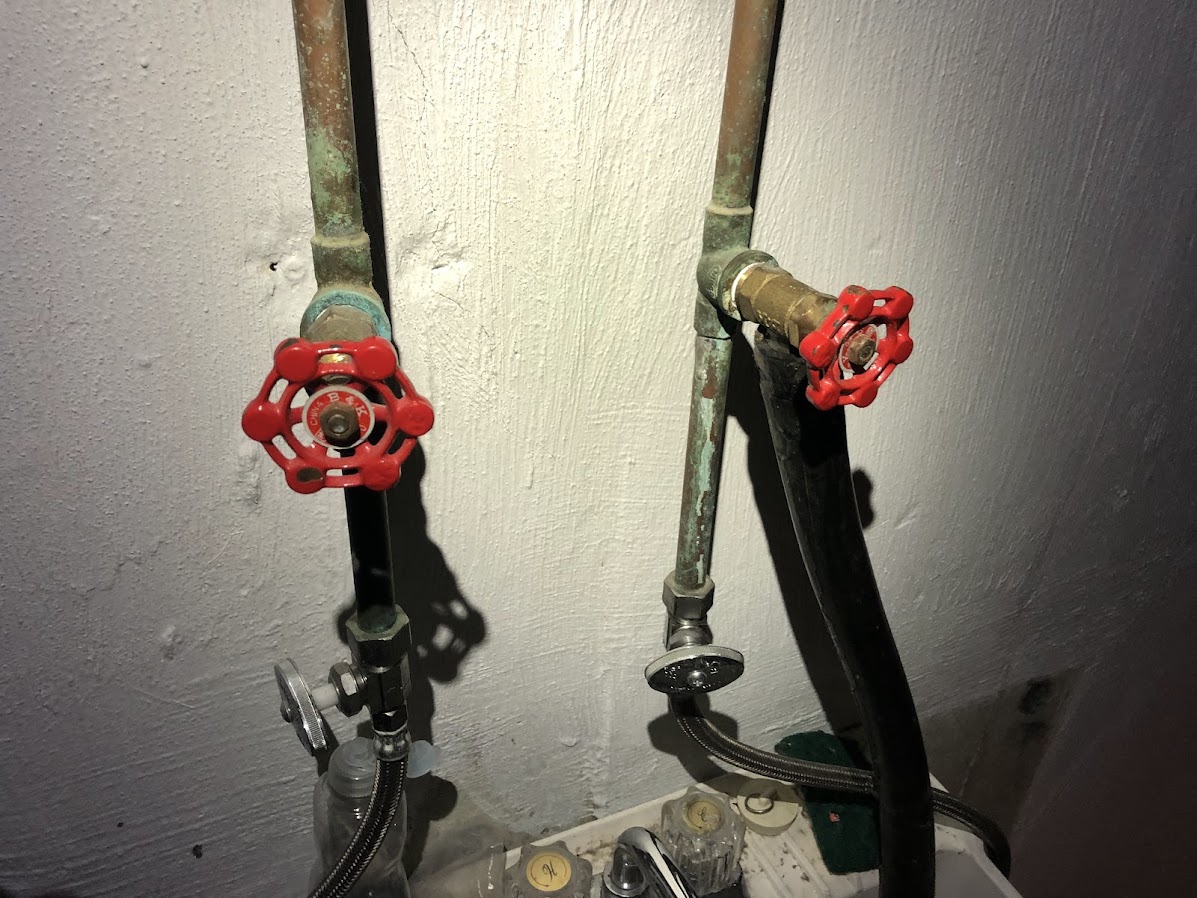
What’s the difference between a main shutoff and the smaller shutoffs, like the ones pictured here?
They serve different purposes, and it’s worth knowing both. A main shutoff valve controls water to the entire house, typically located where the main supply line enters the home, in a basement, crawlspace, or utility area, and is the one to use for a major failure affecting the whole plumbing system. Fixture and appliance-specific shutoffs, like the supply valves pictured here, control water to a single line or fixture, a washing machine, a water heater, a toilet, a sink, and are the faster, more targeted option when the problem is clearly isolated to one appliance or fixture rather than the whole house.
Why would a homeowner want to know about the smaller valves too, not just the main one?
Because shutting off the main valve stops water to the entire house, including things a homeowner might not want interrupted, hot water, other bathrooms, outdoor spigots, while a specific appliance shutoff resolves a washing machine supply line failure without cutting off water everywhere else. Knowing both options means a homeowner can match the response to the actual problem, full shutdown for a major or unclear failure, targeted shutoff for something clearly isolated to one line or fixture.
Where is a main shutoff valve typically located, since it varies by house?
It depends on the home’s age and foundation type, which is exactly why “typically” is doing real work in that sentence. In homes with basements, it’s usually near where the main line enters the foundation wall, often close to a water meter if the home has one indoors. In slab-foundation homes, it may be near the water heater, in a utility closet, or even outside near an exterior wall. Newer homes sometimes have a more visible, prominently labeled shutoff as part of code-driven plumbing layouts, while older homes can have it in a less obvious spot that was never pointed out to a current owner.
What if a homeowner genuinely doesn’t know where theirs is?
That’s a fixable problem, and worth fixing before it’s urgent. A plumber can identify it during any other unrelated service call, and it typically takes a few minutes rather than being its own separate task. Walking the basement, crawlspace, and utility areas looking for a valve on the main incoming line, often larger than fixture-level valves and sometimes paired with a water meter, can also locate it without professional help. The goal isn’t expertise, it’s simply knowing the location before there’s water on the floor and a decision to make quickly.
Once someone finds it, is there anything else worth checking?
Yes, whether it actually turns freely. A shutoff valve that hasn’t been operated in years, particularly an older gate valve like the style pictured here, can seize up or become difficult to close fully after long periods without use. Testing it, turning it closed and back open during a calm, non-emergency moment, confirms it will actually work when it matters, rather than discovering during an active leak that the valve is stuck.
What’s the actual, practical takeaway here?
Two things worth doing this week, not eventually. First, locate the main shutoff valve and any appliance-specific shutoffs for major fixtures, the water heater, washing machine, and dishwasher especially. Second, test that the main valve actually turns. Both take a few minutes combined, and both directly shorten the amount of time water has to spread during exactly the kind of event that turns a small plumbing failure into the material-saturation and mold-risk timeline that a restoration project exists to address.
By the numbers:
- Damp or wet building materials should be removed, cleaned, or dried within 24 to 48 hours to prevent mold growth, per joint EPA/OSHA guidance on disaster and flood cleanup — a window that starts the moment water begins spreading, not when help arrives.
- Roughly 1 in 60 insured U.S. homes files a water damage or freezing claim in a given year, per the Insurance Information Institute, with an average claim cost of $15,400 (2019-2023 average) — a cost curve directly affected by how quickly the water source gets stopped.
Sources: U.S. Environmental Protection Agency and Occupational Safety and Health Administration, joint guide on mold and disaster/flood cleanup; Insurance Information Institute, “Facts + Statistics: Homeowners and Renters Insurance”
Call Ram Restoration for 24/7 water damage response: 937-885-0088 or www.ramrestorationusa.com