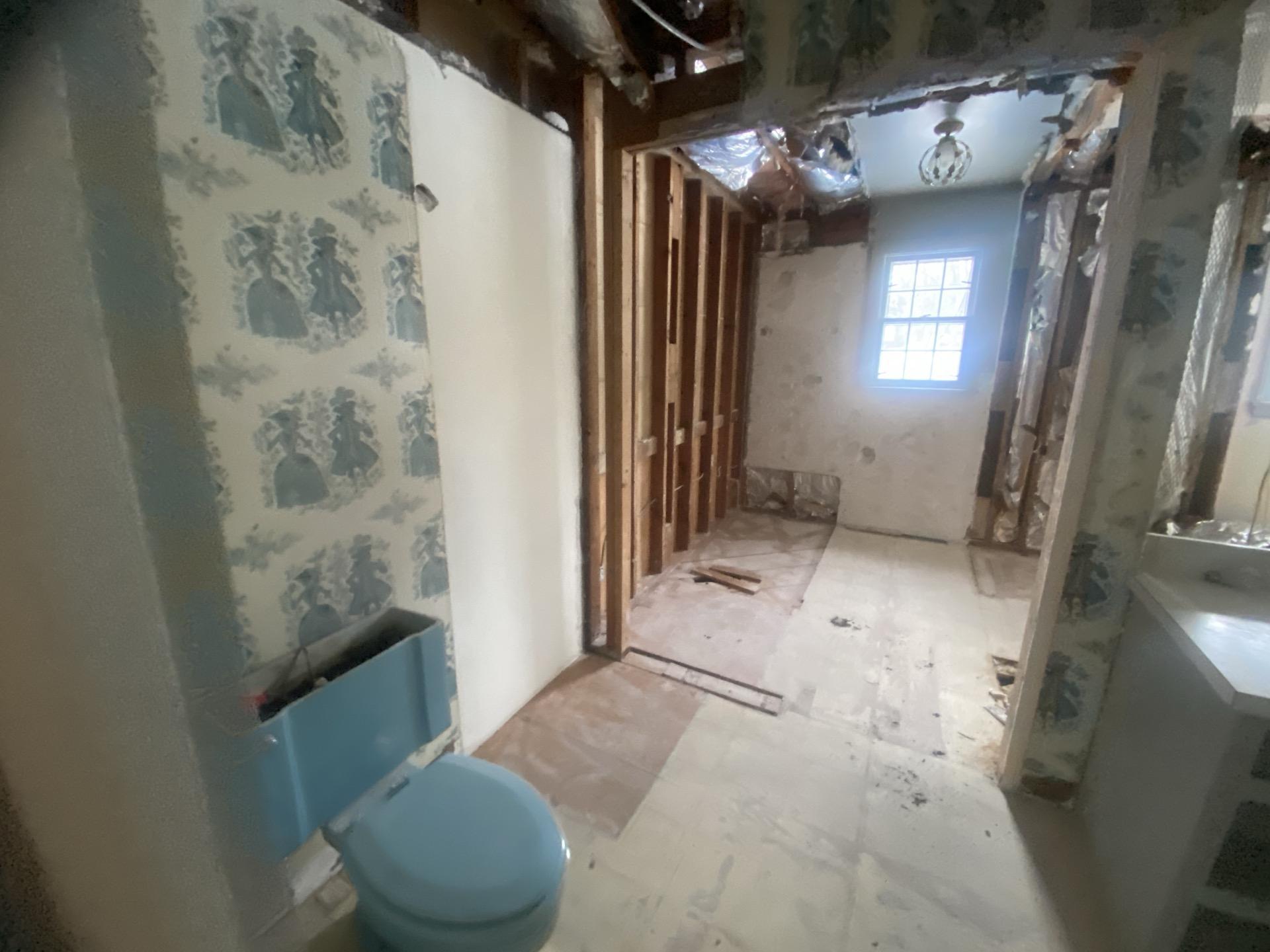
“It’s just a little water” is one of the most expensive sentences in homeownership, and it’s expensive because it’s usually said on day one, before anyone can see what’s actually happening inside the walls and under the floor. Water damage doesn’t wait for a decision to be made. It moves, it wicks, and it changes what’s salvageable on a timeline measured in hours, not days. Understanding that timeline is the difference between a same-week repair and a gut job like the one pictured here, where the wallpaper is still on the wall but everything below it had to come out.
What happens in the first few hours?
Water spreads on contact, and it spreads fast. On a hard floor, it moves across the surface in minutes, finding every gap, seam, and low point in the room. But the more consequential process is happening below what you can see: water in contact with a porous material doesn’t stay put, it wicks upward and outward through capillary action, the same physical process that pulls water up a paper towel. Drywall, wood trim, subfloor, and carpet padding all act like sponges in this sense, and they start absorbing immediately, not after some grace period. A spill that looks contained to one corner of a room at hour one can be measurably wet six feet away by hour six, simply because the materials themselves are doing the spreading.
Different materials absorb at different rates, which is part of why a fast assessment matters. Laminate flooring can trap water underneath the surface layer almost immediately, hiding the problem from view while the subfloor beneath it keeps absorbing. Particleboard or MDF cabinetry, common in kitchens and bathrooms, swells and delaminates faster than solid wood once it’s wet, sometimes within the first day. Carpet padding acts almost like a reservoir, holding far more water than the carpet fiber on top of it ever suggests. None of these reactions wait for someone to decide it’s time to call a professional.
Does the time of year change any of this?
The physical process doesn’t change, but the conditions around it do. Late summer and early fall in the Dayton and Miami Valley area tend to bring higher ambient humidity, which means the air itself has less capacity to help a wet material dry on its own between the event and a professional response. A wet basement in July with the air conditioning running dehumidifies somewhat as a byproduct. The same basement in a stretch of humid, storm-prone weather without that mechanical drying assistance holds onto moisture longer, which effectively shortens the safe window even though the EPA’s 24-to-48-hour guidance doesn’t change with the season.
Why does the 24-to-48-hour mark matter so much?
This is the window the U.S. Environmental Protection Agency points to directly: water-damaged materials need to dry within 24 to 48 hours to prevent mold growth from taking hold. That’s not a conservative buffer, it’s close to the actual biological timeline. Mold spores are present in essentially every indoor environment already, waiting for the conditions to activate, and sustained moisture combined with an organic food source (paper-faced drywall, wood, dust) is exactly the environment they need. Miss that 24-to-48-hour window and a water problem starts becoming a moisture-and-air-quality problem, which is a different, more involved job.
Does drying speed actually change what gets replaced?
Yes, directly, and this is the part that’s easy to underestimate. Wet drywall that gets professionally dried within the first day often survives with nothing worse than a repaint. Wet drywall that sits for three or four days typically has to be cut out, because by then it’s not just wet, it’s beginning to break down structurally and it’s a mold risk regardless of whether growth is visible yet. The same logic applies to subfloor, baseboard, and cabinetry. What’s pictured here, a room stripped down to the joists with the original wallpaper still visible on the surrounding walls, is what happens when water sits long enough that removal becomes the only responsible option, even though the finishes around the affected area were never touched by water directly. Speed is what keeps a job contained to “dry and monitor” instead of expanding into “remove and rebuild.”
Why does humidity keep the clock running even after the visible water is gone?
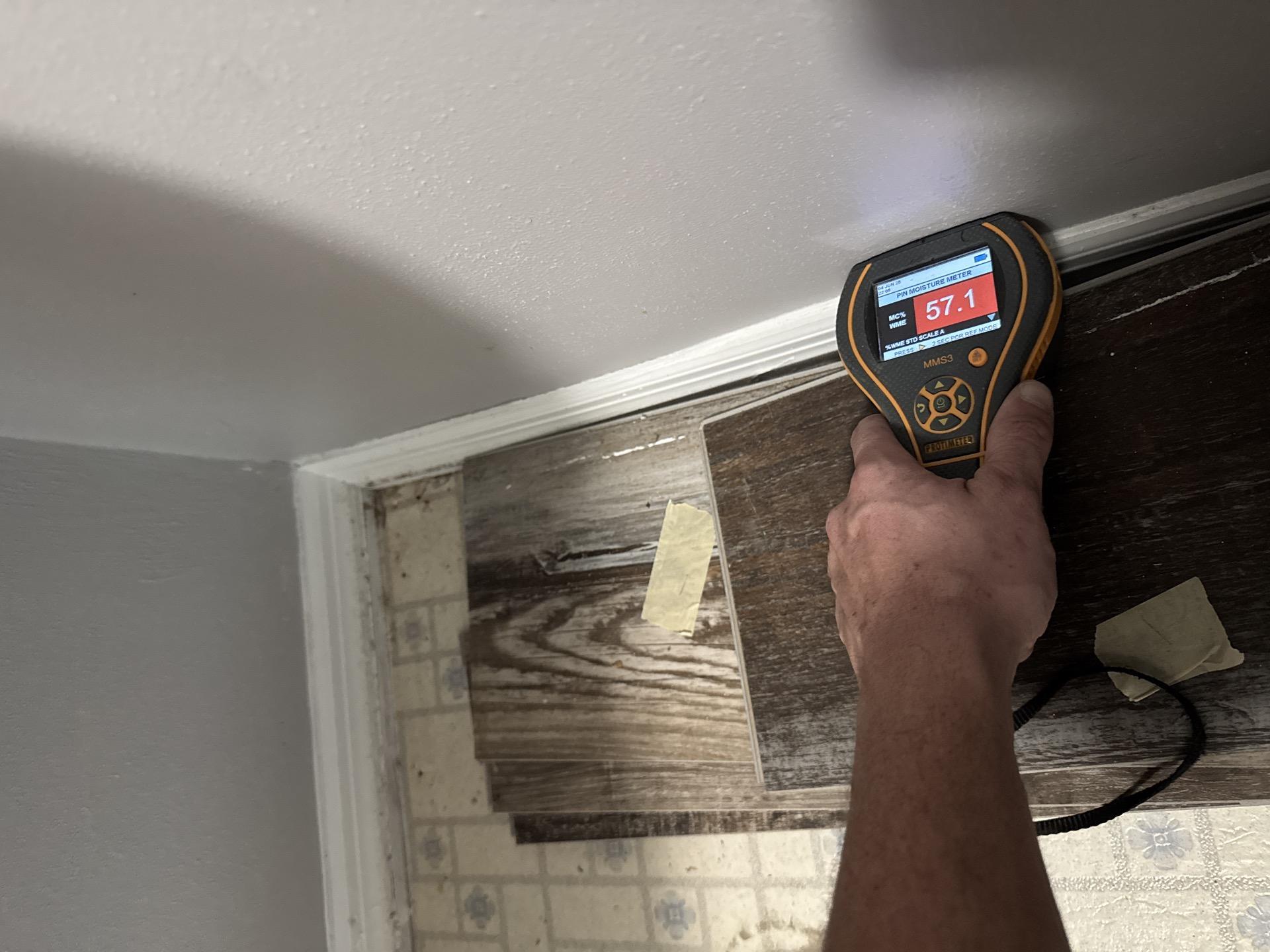
Extracting standing water is the easy, obvious part. Bringing the space back to a safe humidity range is the part that actually finishes the job, and it’s the part a lot of do-it-yourself responses skip. The EPA recommends keeping indoor relative humidity below 60 percent, ideally between 30 and 50 percent, specifically because mold growth accelerates above that threshold. A room can look dry to the eye, no puddles, no visible dampness, while the air and the materials inside it are still sitting well above 60 percent relative humidity. That’s why professional drying uses moisture meters and hygrometers instead of a visual check: the equipment measures the number that actually determines whether mold takes hold, not the number a homeowner can estimate by looking at the floor.
What does this mean for a homeowner deciding what to do right now?
The single highest-leverage decision after any water event is how fast professional drying equipment gets deployed, not how the loss happened or how bad it looks at first glance. A basement supply-line failure that gets responded to within hours can often be fully dried with minimal material loss. The same failure, discovered a few days later because nobody was home, frequently requires the kind of full material removal shown here. The damage isn’t determined only by how much water there was. It’s determined just as much by how long that water, and the humidity it created, was allowed to sit.
By the numbers:
- Water-damaged materials need to dry within 24 to 48 hours to prevent mold growth from taking hold, per EPA guidance on mold and moisture control.
- Indoor relative humidity should stay below 60%, ideally between 30% and 50%, per the same EPA guidance, since mold growth accelerates above that range.
- Roughly 1 in 60 insured U.S. homes files a water damage or freezing claim in a given year, with an average claim cost of $15,400 (2019-2023 average), per the Insurance Information Institute.
Sources: U.S. Environmental Protection Agency, “A Brief Guide to Mold, Moisture and Your Home”; Insurance Information Institute, “Facts + Statistics: Homeowners and Renters Insurance”
Call Ram Restoration to schedule a water damage assessment: 937-885-0088 or www.ramrestorationusa.com