Homeowners watching a restoration assessment usually see the same thing: a technician holds a small device against a wall or trim piece, and a number appears. Without context, that number doesn’t mean much. With context, it’s the whole reason the assessment exists.
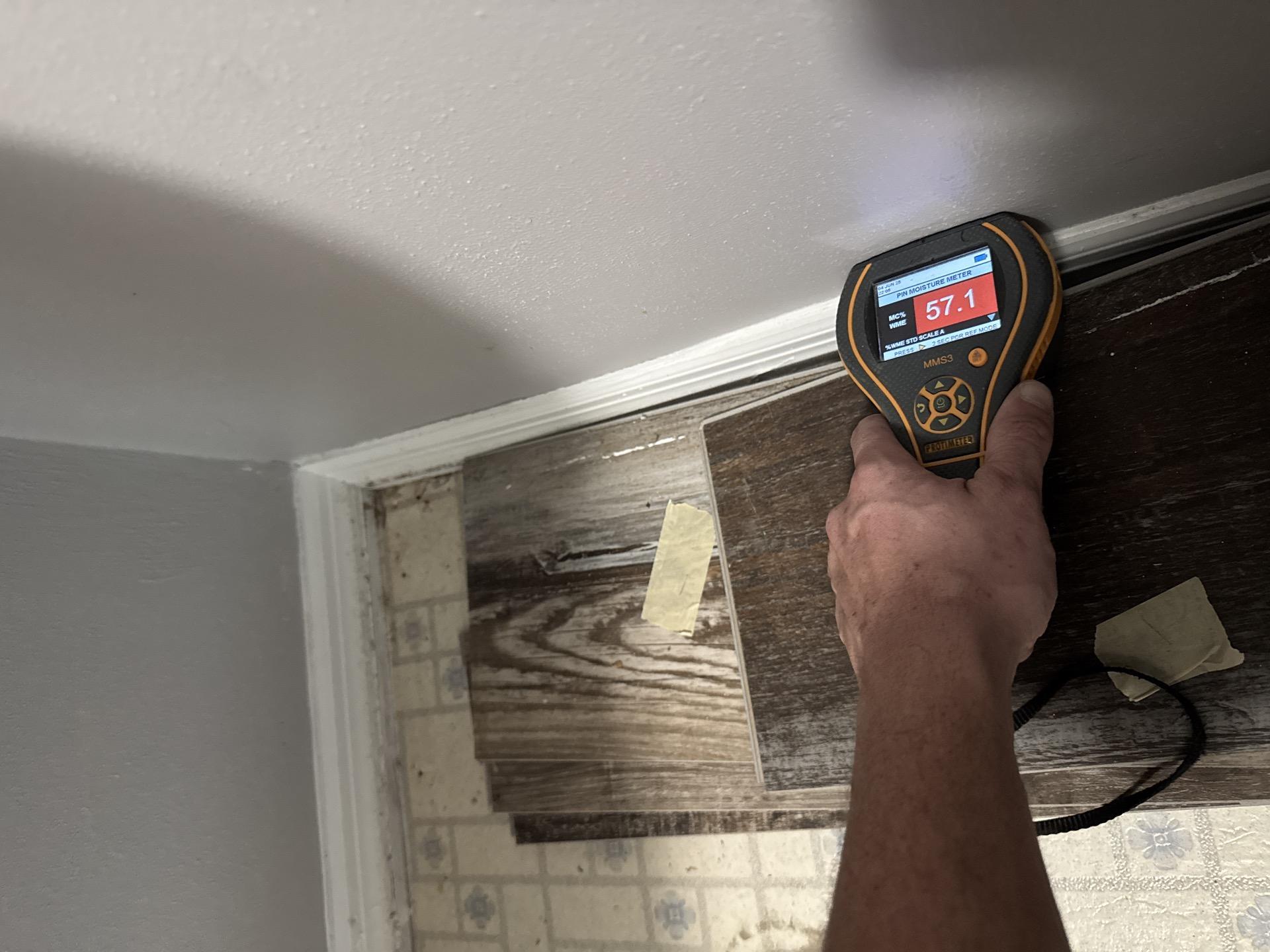
A moisture meter doesn’t just say “wet” or “dry,” it gives a relative reading that gets compared against a dry baseline taken elsewhere in the same structure. A reading close to that baseline means the material is behaving normally. A reading well above it, like the elevated result pictured near this stained tile grout line, tells the technician there’s still moisture present that isn’t visible from a normal walkthrough, and it tells them roughly how much drying work remains. General building science guidance treats wood-based materials as being at meaningfully higher risk for fungal growth once moisture content climbs well past the range considered normal for the region.
This matters because a homeowner’s own walkthrough, however careful, is comparing “does this look wet” against nothing. A professional reading is comparing an actual number against an actual baseline, which is why two rooms that look equally dry to the eye can be in very different places in the drying process.
If a recent storm left water anywhere in a Dayton-area home, the practical takeaway is to ask for the actual readings, not just a verbal “it’s drying nicely.” A number that’s dropping toward baseline on each visit is proof of progress. A number that’s stalled is proof more work, or a different approach, is needed.
By the numbers:
- Moisture meters measure relative to a dry baseline taken elsewhere in the same structure, rather than an absolute universal number.
- Acceptable wood moisture content generally falls between about 9% and 14% depending on regional climate, according to building science guidance.
- Readings that climb well above 14%, and especially those approaching 25%, are widely flagged in building science guidance as an increasing risk for fungal growth in framing and trim.
Source: General building science guidance; Wagner Meters, “Acceptable Moisture Levels in Wood”
Call Ram Restoration to schedule a water damage assessment: 937-885-0088 or www.ramrestorationusa.com