Ask a restoration company what kind of water damage you have, and the answer usually comes back with a number and a letter, something like “Category 2, Class 3.” That’s not industry jargon for its own sake. It’s a classification system that determines what equipment gets used, what materials can be saved versus need to be removed, what protective measures a crew takes, and often what an insurance claim ends up covering. Understanding what those terms actually mean is the difference between following along with your own restoration project and just watching it happen.
Where does this classification system actually come from?
It’s not something individual companies made up to sound technical. The IICRC’s S500 Standard for Professional Water Damage Restoration, developed by the Institute of Inspection, Cleaning and Restoration Certification and accredited under the American National Standards Institute (ANSI) process, is the reference document the restoration industry uses to define both category and class. It’s now in its 5th edition, published in 2021. That matters because it means a technician using these terms is working from a defined, industry-wide standard, not an in-house rule of thumb that varies by company.
What does “Category” actually describe?
Category describes the contamination level of the water itself, not how much damage it caused. Generally speaking, Category 1 refers to water from a clean source, like a supply line break, that hasn’t picked up contaminants. Category 2 (“gray water”) has a significant degree of contamination and could cause discomfort or illness if ingested, such as water from a washing machine or dishwasher discharge. Category 3 (“black water”) is grossly contaminated and can contain pathogens, such as sewage backups or water that has picked up contaminants from the ground. The category isn’t a judgment call made on-site by feel, it’s tied to the water’s source and, in the case of clean water left standing too long, how much time has passed, since even a clean-water event can degrade toward a higher category the longer it sits untreated.
Why does contamination category change how a crew actually works?
Because it directly determines protective equipment, containment, and what happens to affected materials. A Category 1 event might allow certain porous materials to be dried in place. A Category 3 event generally does not, because the safety and health considerations around grossly contaminated water mean affected porous materials are typically removed and discarded rather than dried, regardless of how structurally sound they otherwise are. This is a genuinely important distinction for a homeowner to understand, because it explains why two water events that look similarly “wet” from the outside can result in very different scopes of work, one a drying job, the other a removal-and-rebuild job.
What does “Class” describe, and how is it different from Category?
Class is a separate measurement entirely, it describes the amount of water and how much of the structure and its materials have absorbed it, which determines the drying approach and equipment needed, not the contamination level. Class 1 involves the least amount of water absorption, affecting only part of a room with materials that have absorbed minimal moisture. Class 4 involves specialty drying situations, where water has saturated low-permeance materials like hardwood, plaster, or concrete, requiring longer drying times and specialized methods. A Category 1, Class 4 situation, clean water that has deeply saturated a dense material, is a real and specific combination, just as much as a Category 3, Class 1 situation is. The two scales measure different things, and a full assessment needs both.
Why does a homeowner rarely hear these exact terms explained?
Probably because “Category 2, Class 3” doesn’t mean much without context, so a lot of restoration communication skips straight to the practical result (“this needs to be removed,” “this can be dried”) without explaining why. That’s understandable, but it leaves homeowners without the ability to ask an informed question or sanity-check what they’re being told. Knowing that category drives contamination-based decisions and class drives water-volume-based decisions gives a homeowner a real framework for that conversation, instead of just trusting a number they don’t understand.
How does this classification actually get documented, and why does that matter for a claim?
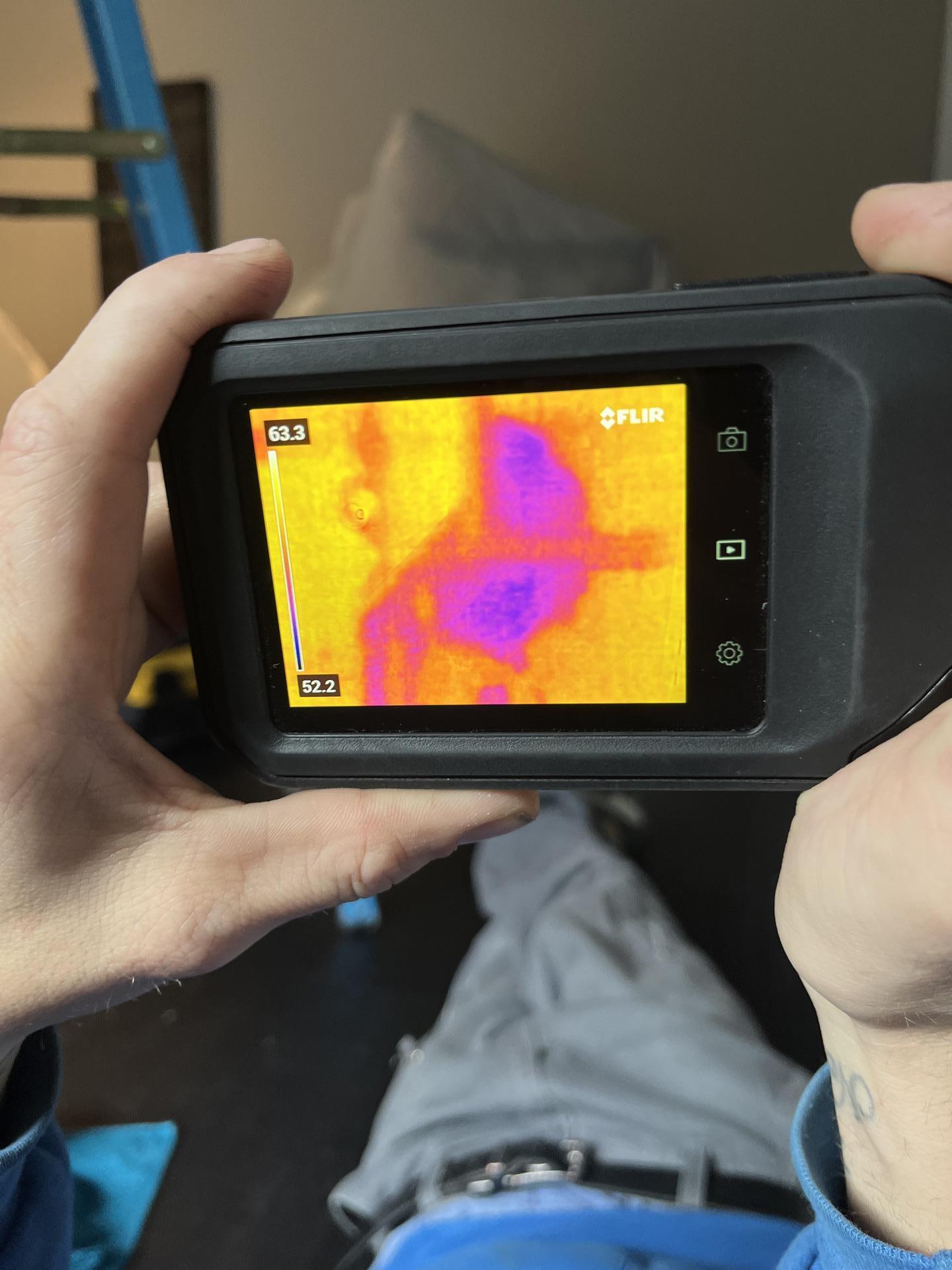
A thorough initial assessment records both category and class, typically backed by moisture readings and, increasingly, thermal imaging like the kind pictured here, which shows how far moisture has traveled into materials that look dry on the surface. That documentation is what justifies the scope of work to an insurance adjuster later, why certain materials were removed rather than dried, why specific drying equipment ran for a specific number of days. A claim supported by category-and-class documentation, backed by actual readings, holds up better than one supported by a general description of “water damage.”
What should a homeowner ask when a restoration company arrives?
It’s reasonable to ask directly what category and class the technician is assessing, and why, since a company that can explain both in plain terms is demonstrating that the assessment is following an actual standard, not a guess. It’s also worth asking what documentation is being captured to support that assessment, since that’s the same documentation your insurance claim will likely rely on later.
By the numbers:
- The IICRC S500 Standard for Professional Water Damage Restoration, developed under an ANSI-accredited consensus process, is now in its 5th edition, published in 2021.
- Category 3 water, “black water,” is defined as grossly contaminated and capable of causing severe illness or death if ingested, per the S500 standard’s contamination classification.
- Roughly 1 in 60 insured U.S. homes files a water damage or freezing claim in a given year, per the Insurance Information Institute — a large enough share that understanding this classification system has real, practical value for most homeowners eventually.
Sources: Institute of Inspection, Cleaning and Restoration Certification (IICRC), S500 Standard for Professional Water Damage Restoration, 5th Edition (2021); Insurance Information Institute, “Facts + Statistics: Homeowners and Renters Insurance”
Call Ram Restoration for a water damage assessment: 937-885-0088 or www.ramrestorationusa.com