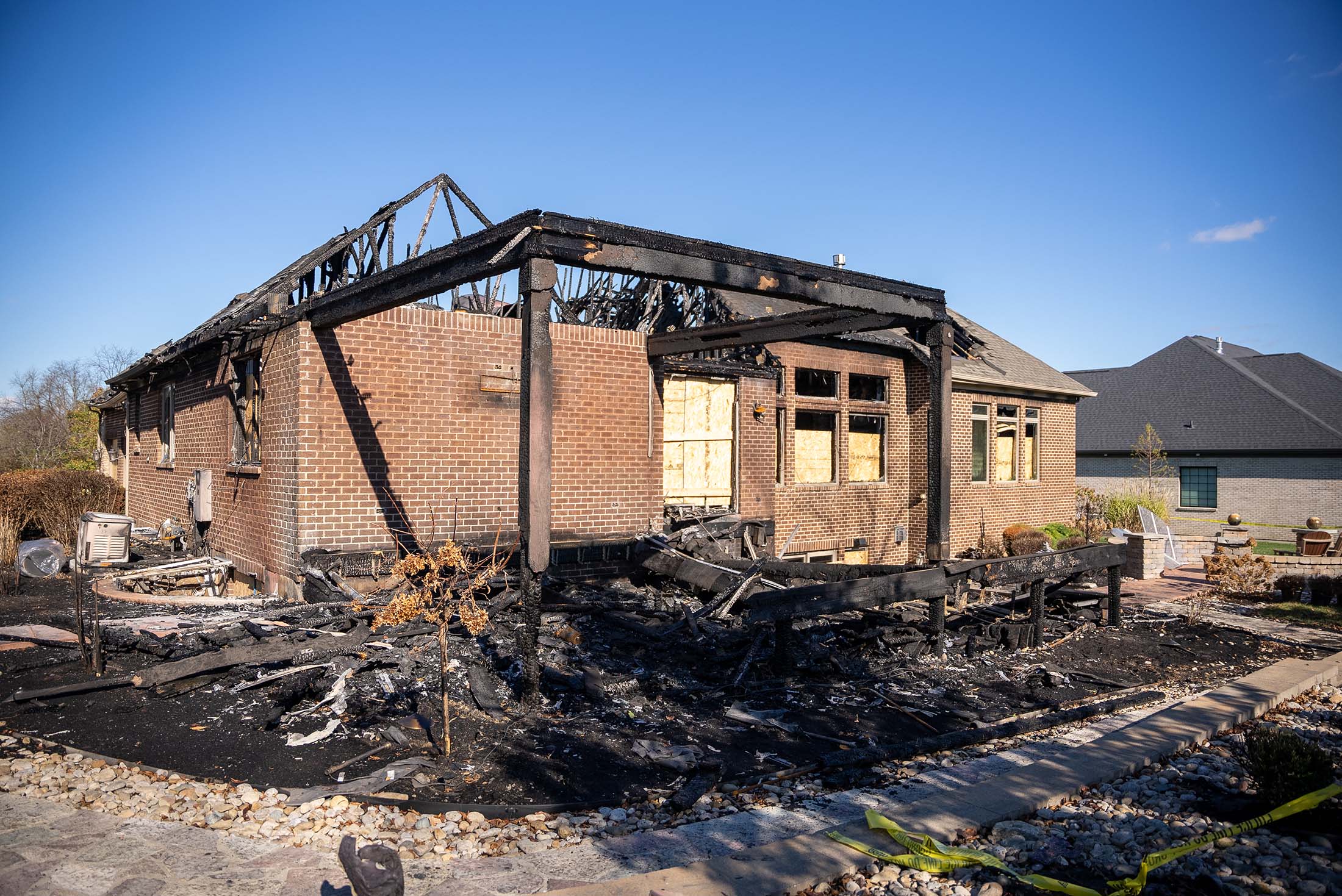
A house fire produces two distinct kinds of damage, and they don’t require the same response. Fire damage is what burned, and the answer to it is usually structural: demolition, rebuilding, replacing what’s gone, the kind of loss pictured here, where roof trusses collapsed and the structure itself failed. Smoke damage is what didn’t burn but was still affected, and the answer to it is a different discipline entirely, closer to specialized cleaning and air-quality restoration than construction. Treating both as one undifferentiated “fire cleanup” job is one of the more common ways homeowners and even some contractors underestimate the actual scope of recovery.
What exactly counts as fire damage versus smoke damage?
Fire damage is direct: charring, structural failure, anything the flames themselves consumed or compromised. It’s visually obvious, and it’s why a severely fire-damaged structure, like the one shown here with its collapsed back roofline, is treated first and foremost as a construction and structural-engineering problem before it’s treated as a cleaning problem. Smoke damage is indirect and far less visually obvious. It’s the residue, odor, and chemical soiling left on surfaces, materials, and systems that the fire itself never touched, sometimes in rooms on the opposite side of the house from where the fire started.
Why does smoke reach areas the fire never did?
Smoke is made up of microscopic particles and gases small enough to travel wherever air moves, which in most homes means through the HVAC system and any open pathway between rooms. A fire contained to one room can still coat ductwork, closets, and furnishings throughout the house with a fine layer of soot and residue, because the smoke generated by that fire kept moving long after the flames themselves were extinguished. This is precisely why a newly published national standard exists specifically for this problem: the ANSI/IICRC S700 Standard for Professional Fire and Smoke Damage Restoration, First Edition 2025, which provides a defined set of principles, methods, and processes covering the entire evaluation, mitigation, cleaning, and restoration process for fire and smoke damaged structures, materials, assemblies, and systems.
Does fire damage cleanup use the same standard as smoke damage cleanup?
They fall under the same governing standard, S700, but the actual work looks different depending on which type of damage is being addressed. Structural fire damage, like the collapsed framing pictured here, is addressed through demolition, structural assessment, and rebuilding, work that follows building codes and structural engineering practice as much as it follows restoration protocol. Smoke damage is addressed through a completely different toolkit: specialized cleaning agents matched to the type of residue, HVAC system cleaning or replacement, sealing and repainting affected surfaces, and, in more severe cases, thermal fogging or ozone treatment to address odor at the molecular level rather than just masking it.
Can a house have serious smoke damage without serious fire damage?
Yes, and this is one of the more counterintuitive parts of fire recovery. A small, contained fire, a kitchen grease fire that never spreads past the stovetop, for example, can still generate enough smoke to leave residue and odor throughout an entire house, particularly if the HVAC system was running when the fire occurred. In cases like this, the fire damage itself might require minimal repair, while the smoke damage cleanup, addressing every room the ductwork serves, ends up being the larger and more involved part of the job.
Why does the type of material matter for smoke cleanup specifically?
Because different materials absorb and hold smoke residue differently, and that determines whether cleaning is even the right approach versus replacement. Porous materials, drywall, insulation, carpet padding, upholstery, tend to absorb smoke odor deeply enough that surface cleaning doesn’t fully resolve it, which is often why affected drywall gets removed rather than just repainted. Non-porous, hard surfaces, tile, sealed wood, glass, generally clean more successfully because the residue sits on the surface rather than soaking into it. Part of a proper fire and smoke assessment is determining, material by material, which category each affected surface falls into, rather than applying one blanket approach to the whole house.
Does one type of damage typically take longer to resolve than the other?
Often, yes, and not in the direction people expect. Structural fire damage, even severe damage like the collapsed framing pictured here, has a definable scope once a structural assessment is complete: what needs to be demolished, what needs to be rebuilt, and a construction timeline that follows from that scope. Smoke damage cleanup can actually take longer to fully resolve, because odor and residue removal is iterative rather than purely constructive. A first round of cleaning and deodorizing addresses the majority of the problem, but confirming an odor is genuinely gone, not just temporarily masked, sometimes requires a follow-up assessment days or weeks later, particularly in cases where ductwork or dense porous materials were heavily affected. A homeowner who expects smoke cleanup to wrap up as quickly as demolition and framing repair is sometimes surprised when the odor question takes longer to close out than the structural one.
What should someone recovering from a house fire actually expect?
Two separate scopes of work running in parallel, not one. The structural side addresses what actually burned, which for a loss like the one pictured here means demolition and rebuilding under proper structural oversight. The smoke side addresses everything the fire’s byproducts reached but didn’t destroy, following the S700 standard’s cleaning and restoration protocols room by room, material by material. A recovery plan that only accounts for the visible structural damage and treats smoke cleanup as an afterthought is the most common reason homeowners end up dealing with lingering odor or air-quality complaints long after the visible repairs are finished.
By the numbers:
- The ANSI/IICRC S700 Standard for Professional Fire and Smoke Damage Restoration, First Edition 2025, is the restoration industry’s newly published governing reference covering evaluation, mitigation, cleaning, and restoration of fire and smoke damaged structures.
- U.S. fire departments responded to an estimated 1.39 million fires in 2024, causing 3,920 civilian deaths and $19.1 billion in direct property damage, according to NFPA research.
- Home fires accounted for 75% of civilian fire deaths and injuries in 2024, per the same NFPA research.
Sources: ANSI/IICRC S700, Standard for Professional Fire and Smoke Damage Restoration, First Edition 2025 (IICRC); National Fire Protection Association, “Fire Loss in the United States During 2024”
Call Ram Restoration for fire and water damage restoration: 937-885-0088 or www.ramrestorationusa.com