“Water damage” and “flood damage” sound like the same thing, and most homeowners assume their insurance treats them that way too. It doesn’t. This is one of the more consequential misunderstandings in homeowners insurance, confirmed directly by the organization that regulates it, and it’s worth understanding before a heavy rain event or a rising water table makes the distinction matter.
Is it actually true that standard homeowners insurance doesn’t cover flood damage?
Yes, stated plainly by the National Association of Insurance Commissioners: “flood peril is not typically covered through most homeowners and renter’s insurance policies.” The NAIC’s consumer guidance is direct about this, standard homeowners insurance generally excludes flood damage as a category, regardless of how the water actually entered the home. This isn’t a rare exclusion buried in fine print, it’s a standard, industry-wide structure, which is exactly why it catches so many homeowners off guard.
If a standard policy doesn’t cover flood, what does it actually cover?
Most standard homeowners policies cover sudden, accidental water damage from specific covered perils, a burst pipe, an appliance malfunction, storm damage that lets rain into the home through a hole in the roof. What they generally exclude is flood, water that rises from an external source, groundwater, an overflowing river or creek, or water that enters a home broadly from surface-level flooding rather than a specific interior failure. The practical distinction often comes down to where the water originated, not how much damage it caused or how it looks once it’s in the house.
How many homeowners actually think they’re at risk of flooding?
Fewer than you’d expect, given how often flooding actually occurs. A 2023 Triple-I/Munich Re consumer survey found that only 22% of homeowners reported believing they are at risk of flood. Flood risk perception tends to track visible risk, living near a river, in a coastal area, in a mapped floodplain, rather than the broader reality that heavy rainfall, poor drainage, and groundwater can cause flooding well outside those obvious zones.
Even among homeowners who do think they’re at risk, how many actually have coverage?
Better, but still not universal. Of the homeowners who reported flood risk in that same survey, 78% said they carry flood insurance, split between 43% through the National Flood Insurance Program and 35% through a private flood insurance provider. That means even within the group that correctly identifies their own risk, roughly 1 in 5 still isn’t covered, and that’s the more risk-aware group. The much larger group, the 78% who don’t think they’re at risk at all, is presumably far less likely to carry flood coverage, even though basement and groundwater flooding isn’t limited to mapped flood zones.
Does this actually matter in the Dayton/Miami Valley area specifically?
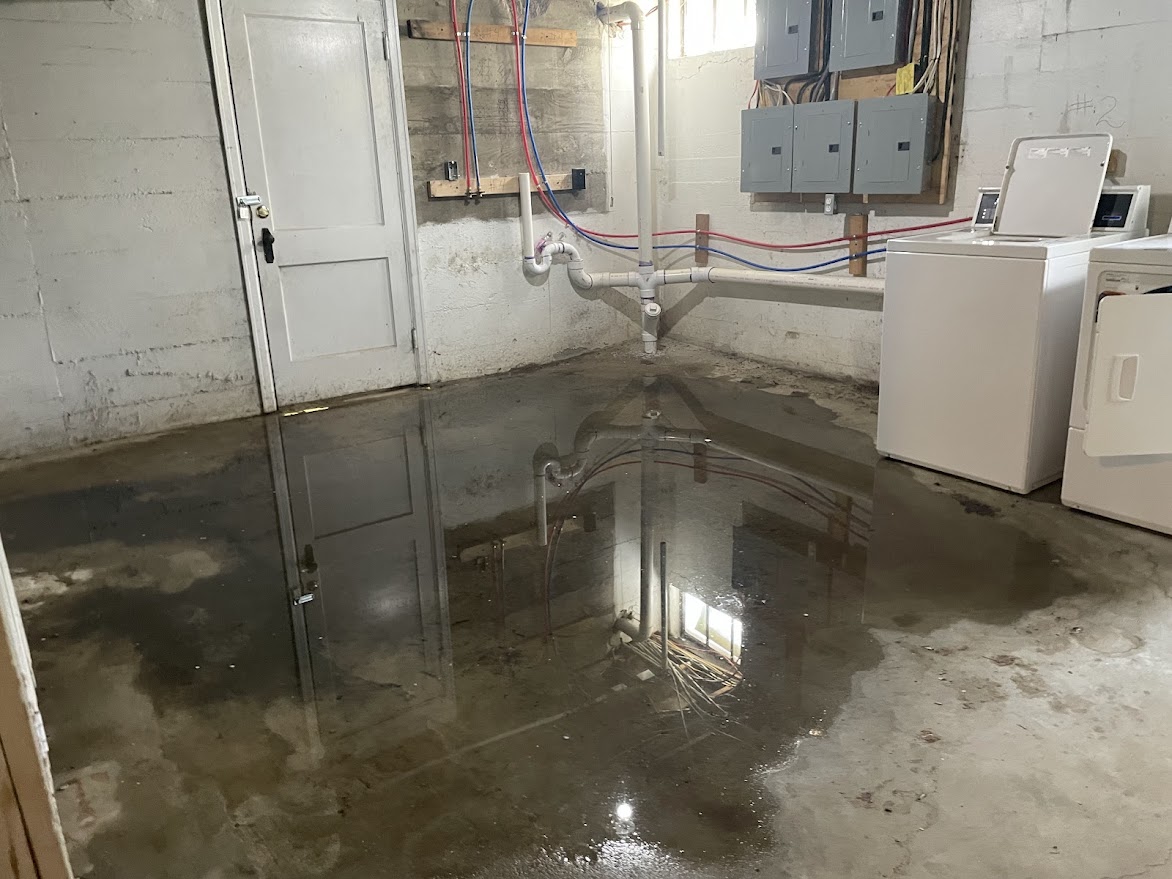
It matters more than the phrase “flood zone” suggests, because a large share of the flooding that affects homes in this region isn’t the dramatic, rising-river kind. Basement water intrusion from heavy rain events, poor exterior drainage, or a high water table, the kind of standing water pictured here, can qualify as flood damage under the flood-versus-water-damage distinction even though it never involved an overflowing river anywhere nearby. A homeowner who has never thought about flood insurance because they don’t live near water can still be excluded from standard coverage for exactly this kind of event.
So how does a homeowner actually find out whether they’re covered?
Directly, by asking an insurance agent specifically whether the policy includes flood coverage, and if not, what it would cost to add it, either through the NFIP or a private flood insurance option. This isn’t a question most homeowners think to ask, because the assumption is that “water damage” is one category. Confirming the actual scope of a policy, in writing, before an event happens, is the only way to know for certain rather than finding out during a claim.
What’s the practical difference this makes if a basement floods?
If the cause qualifies as flood under the policy’s definition and there’s no flood coverage in place, the homeowner is paying for cleanup, drying, and reconstruction out of pocket, potentially a significant cost depending on the extent of the damage. If the same event is classified as a covered water-damage peril instead, the standard policy applies. The distinction isn’t academic, it’s the difference between a covered claim and a five-figure expense, and it’s determined by a definition most homeowners have never actually read in their own policy.
What’s the realistic first step here?
Pull out the actual policy, or call the agent, and ask the specific question: is flood damage covered, and what exactly counts as flood under this policy’s definition. It’s a five-minute conversation that resolves a genuinely consequential unknown, and it’s a meaningfully better time to have that conversation than during a claim.
By the numbers:
- Standard homeowners and renters insurance policies typically do not cover flood damage, per the National Association of Insurance Commissioners’ consumer guidance.
- Only 22% of homeowners reported believing they are at risk of flood, per a 2023 Triple-I/Munich Re Consumer Survey.
- Among homeowners who do recognize their flood risk, 78% carry flood coverage, split between 43% through the National Flood Insurance Program and 35% through private flood insurance, per the same survey.
Sources: National Association of Insurance Commissioners (NAIC), consumer guidance on flood insurance; Insurance Information Institute (Triple-I), 2023 Triple-I/Munich Re Consumer Survey, “Facts + Statistics: Flood Insurance”
Call Ram Restoration for water damage assessment and restoration: 937-885-0088 or www.ramrestorationusa.com