“Just clean the gutters” is common fall advice, but it undersells what a gutter system actually has to handle once leaves start coming down and fall rain starts falling. The volume of water moving off an average roof during a normal rainstorm is larger than most homeowners picture, which is exactly why a partially clogged gutter doesn’t just get a little less effective, it can get overwhelmed outright.
How much water actually comes off a roof during a normal rain?
More than intuition suggests. A widely-used extension-service figure puts it at roughly 62 gallons of runoff for every 100 square feet of roof surface per inch of rainfall. Scale that up: a modest 1,500-square-foot roof footprint sheds roughly 930 gallons during a single inch of rain, and Dayton-area fall months aren’t stingy with rain, October and November both average right around 3 inches per month. That’s not a once-a-season event, either; it’s the routine volume a gutter system is expected to handle, rain by rain, all fall long.
Does gutter capacity actually matter, then, or is that just a sales pitch?
The physics say it matters, but it’s worth being honest about what’s marketing versus what’s engineering here. Larger-capacity gutter profiles do move more water per linear foot before overflowing, which is real and meaningful on a roof with a large catchment area feeding a short run of gutter. That said, be skeptical of specific “gallons per foot” numbers thrown around without a source, capacity varies by gutter profile and manufacturer, and a number that sounds precise isn’t automatically accurate. The more reliable takeaway isn’t a specific capacity figure, it’s that a gutter system sized appropriately for the roof area it serves, and kept clear of debris, handles fall rain volume the way it was designed to. A correctly-sized, clogged gutter will still overflow. An oversized, clogged gutter will overflow too, just slightly later.
Why does a clog matter so much if the gutter itself is “big enough”?
Because capacity assumes an open channel, and a clog doesn’t reduce capacity proportionally, it can eliminate it at that point entirely. A few inches of compacted, wet leaves sitting at a downspout opening doesn’t just slow drainage, it can block it outright, which means the water arriving at that section has nowhere to go but over the front edge, regardless of how large or well-engineered that gutter profile is. The math above (62 gallons per 100 square feet per inch of rain) assumes that water actually makes it into the downspout. A clog breaks that assumption entirely, at exactly the section where it’s blocked.
Where does the moisture-timeline piece fit into all of this?
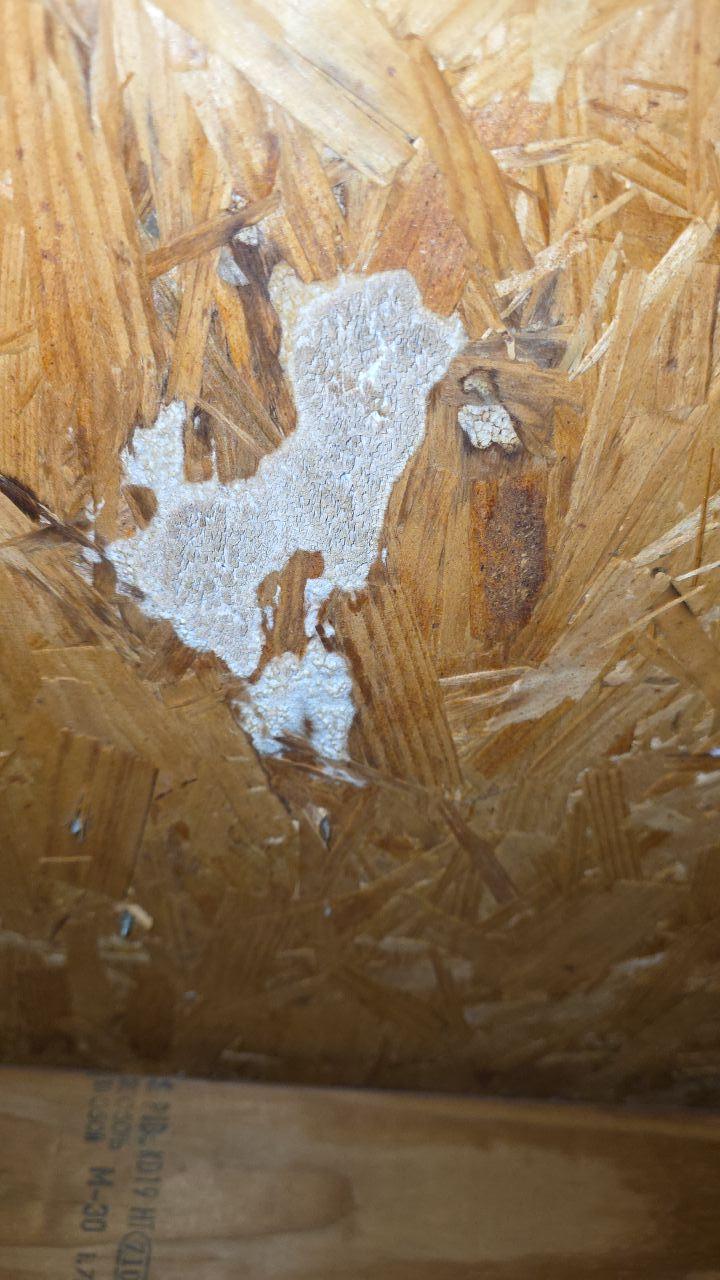
This is the part that connects gutter overflow to an actual materials and mold-risk question, not just a drainage inconvenience. The same EPA guidance that governs any water event in a home, dry water-damaged materials within 24 to 48 hours to prevent mold growth, applies here too, it’s just triggered differently. A single storm doesn’t necessarily push a chronically-overflowing gutter situation past that window on its own. A fall rain pattern that delivers a few inches of overflow-driving rain across several separate events over a few weeks absolutely can, because the affected wood (fascia, roof deck edge, sometimes attic sheathing if water is working its way under shingles) never gets a full drying cycle between events. What’s pictured here, staining on the underside of roof deck sheathing inside an attic, is a realistic example of what that slower, cumulative moisture exposure looks like once it’s had enough time and enough repeated wetting to show up as a visible material change.
Does one clogged gutter section actually add up to a real mold-timeline risk, or is that overstating it?
It depends entirely on how long the clog sits and how much rain moves through during that window, which is exactly why “I’ll get to it eventually” is a riskier plan in October than in June. A clog that forms and gets cleared within a few days, even during a rainy stretch, is unlikely to push any affected material past a safe drying window. A clog that sits through several weeks of fall storms, with the same board or roof deck section getting wet, partially drying, and getting wet again repeatedly, is a genuinely different exposure pattern than a single acute event, and it’s the pattern most likely to eventually show up as the kind of staining pictured here.
What’s the practical number a homeowner should actually take from this?
Not a precise gallons-per-foot capacity spec, but the two figures that actually matter: roughly 930 gallons moving off a typical roof per inch of rain, and roughly 3 inches of rain in a typical Dayton fall month. Multiply those out across a season and it’s clear a clogged section isn’t dealing with an occasional light shower, it’s dealing with real, repeated volume. A gutter cleared before leaf-drop season peaks, and checked again mid-season, is handling that volume the way it’s supposed to. One left alone through October and November is not.
By the numbers:
- Roughly 62 gallons of water run off a roof for every 100 square feet of roof surface per 1 inch of rainfall, per Washington State University Extension’s roof-runoff guidance.
- Dayton, Ohio’s normal precipitation is 2.95 inches in October and 3.07 inches in November, per NWS climate normals for the Dayton station.
- Water-damaged materials need to dry within 24 to 48 hours to prevent mold growth from taking hold, per EPA guidance on mold and moisture control — a window that a chronically-clogged gutter can quietly violate over several repeated wetting cycles even without one single dramatic event.
Sources: Washington State University Extension, “Managing Roof Runoff”; National Weather Service, Wilmington OH office, Dayton climate normals; U.S. Environmental Protection Agency, “A Brief Guide to Mold, Moisture and Your Home”
Call Ram Restoration for a water damage assessment: 937-885-0088 or www.ramrestorationusa.com
Related reading
- Why Are My Fascia Boards Rotting? How Overflowing Gutters Damage Your Roofline Before You Ever See a Leak
- What Happens to Your Sump Pump When the Power Goes Out During a Storm?
- Why This Summer’s Heat Is Fueling Dayton’s Basement-Flooding Storms
- Residential restoration services